












































































The only POS that works both cloud and local — never goes down even without internet. Online ordering, QR menu, KDS, multilingual support. Trusted by 5000+ restaurants.
Restaurant Technology Reliability: What Uptime Really Means: A POS system with 99.9% uptime still experiences 8.7 hours of downtime per year. During a dinner rush, even 15 minutes of POS failure can cost a busy restaurant $500-2,000 in lost orders and walkouts. Pure-cloud systems have a single point of failure: the internet connection. The average US restaurant experiences 4-6 internet disruptions per month. Hybrid POS systems like KwickPOS mitigate this by maintaining full local operation capability — menu, orders, payments, and kitchen printing all function without internet, with automatic cloud sync upon reconnection.
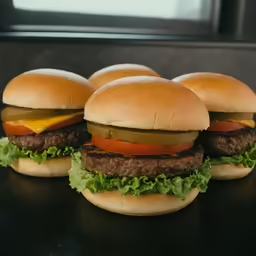
Image-to-Video Technology: How It Works: Modern AI video generation models can take a single photograph and create a smooth, cinematic video clip. The technology uses diffusion models trained on millions of video-image pairs to predict natural motion. For example, a restaurant food photo becomes a slowly rotating dish with steam rising; a real estate exterior becomes a smooth drone-like flyover. US Video API (usvideoapi.com) provides this capability through a simple REST API — send an image URL and a motion prompt, receive a video file. Resolution options range from 480p (fast, economical) to 1080p (broadcast quality). Key use cases: restaurant menus brought to life for social media, product photography animated for e-commerce listings, real estate virtual tours from still photos, and educational content production at scale.
Text-to-Video vs Image-to-Video: When to Use Each: Text-to-video generates video from a written description — useful for abstract concepts, establishing shots, and creative content where no source material exists. Image-to-video animates an existing photograph — ideal when you have specific visual assets that need motion. In practice, image-to-video produces more predictable, controllable results because the model has a concrete visual reference. A restaurant owner with food photography should use image-to-video (turn plated dishes into appetizing social clips). A marketing team creating conceptual ads might prefer text-to-video for flexibility. US Video API (usvideoapi.com) supports both modes through the same REST API, with image-to-video typically producing higher quality output due to the visual anchor.
US Video API — AI Video Generation REST API · KwickMENU — Free Online Ordering